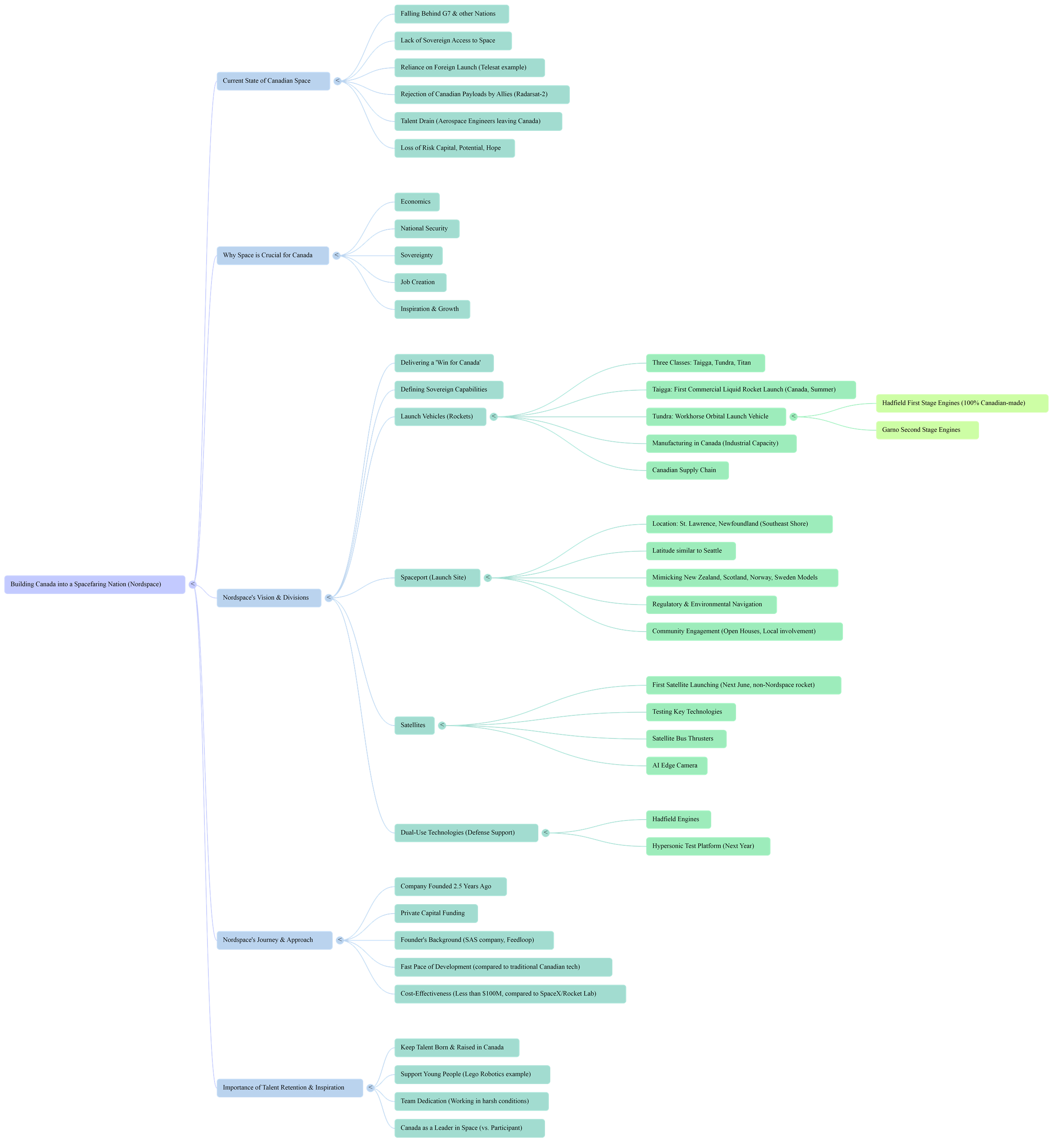
This briefing document summarises key themes and facts from the “NordSpace – BetaKit Talk – Building Canada into a Spacefaring Nation” source, providing insights into NordSpace’s mission, current challenges, and proposed solutions for Canada’s space industry.
1. Canada’s Current Position: Falling Behind
The speaker highlights Canada’s significant decline in the global space sector, stating, “we’ve been falling behind for many decades now to a point where we’re the only G7 nation that doesn’t really have sovereign access to space. We’re behind about two dozen other countries that are really pushing on this frontier.” This lack of sovereign access has tangible negative consequences:
- Economic Leakage: TelSat, a Canadian company, spends “a billion and a half Canadian dollars roughly to launch from the United States,” rather than within Canada, representing a significant loss of domestic economic activity and taxpayer funds.
- National Security Vulnerability: The speaker recounts a critical incident where “even our closest neighbours and allies and friends the United States from a national security standpoint have rejected Canadian payloads in the past including our flagship radar satu costed Canadian taxpayers $200 million.” This forced Canada to launch with Russia, a politically untenable option today.
- Talent Drain: Canada is losing its brightest minds in aerospace, with the speaker noting that “most of my colleagues are no longer in Canada. These are the most talented, the hardest working, the most passionate people you’ll ever meet and we’re losing talent, we’re losing risk capital, we’re losing potential and I think we’re losing hope.” This is described as a “slow drip” akin to an “Avro style moment.”
2. NordSpace’s Vision: Sovereign Capabilities and a National Victory
NordSpace aims to reverse this trend by establishing Canada as a “true space fairing nation, one that’s competitive, one that’s respected, one that’s highly capable, one that can retain talent.” Their overarching goal is to deliver “a win for Canada, something that everyone in this room and across the country can own a national victory that I think others like the Americans have done so well that have galvanised their people.”
NordSpace defines “sovereign capabilities for space as building Canadian satellites, launching them on a Canadian rocket and launching them from a Canadian spaceport.” They are ambitiously pursuing all three:
2.1. Canadian Launch Vehicles: Taiga, Tundra, and Titan
- Three Classes: NordSpace is developing three classes of launch vehicles: Taiga, Tundra, and Titan.
- Taiga: The Taiga rocket is scheduled for launch “this summer,” marking “the first liquid rocket commercial launch in Canadian history” from a Canadian spaceport.
- Tundra: Tundra will be their “workhorse orbital launch vehicle,” powered by “100% Canadian-made Hadfield first stage engines and Garno second stage engines.”
- Domestic Manufacturing & Supply Chain: A core principle is to “build this kind of industrial capacity here,” with “a completely Canadian supply chain” and extensive in-house manufacturing. This includes the Hadfield engine, described as a “compact engine” developed domestically.
2.2. Canadian Spaceport: Newfoundland
- Strategic Location: NordSpace is establishing a spaceport in St. Lawrence, Newfoundland, on the southeast shore. The speaker notes it’s at “the same latitude as Seattle,” challenging the perception that Canada is “too far north” for space launches.
- International Precedent: This location aligns with similar developments in “New Zealand, Scotland, Norway, Sweden,” demonstrating feasibility.
- Community Engagement: The project actively involves the local community in St. Lawrence, a fishing town, through “open houses” and “little rocket launches” to engage children and locals, extending the “tech hub” concept beyond major cities. The speaker envisions it as “the most beautiful launch site in the entire world.”
2.3. Canadian Satellites & Dual-Use Technologies
- First Satellite: NordSpace is currently building its “first satellite,” slated for launch “next June,” which will test “key technologies including our satellite bus thrusters and an AI edge camera.”
- Hypersonic Test Platform: Significantly, NordSpace is “dual-using as many of our technologies as possible,” specifically their Hadfield engines, in a “hypersonic test platform” for defence applications, supporting “Canada’s growing investment and efforts in defence.”
3. Business Model and Funding
NordSpace’s rapid progress over two and a half years is attributed to a unique funding approach:
- Private Capital First: The founder explicitly states, “private capital money moves everything.” After graduating, he “did what most people might do and start a SAS company… with the express intent to reinvest everything I could back into NordSpace.” This approach aimed to avoid “having to fight for… government funds and small bits of investment to move the needle.”
- Efficiency and Cost-Effectiveness: The speaker challenges the perception of space as prohibitively expensive for Canada, stating, “people think oh this is going to be like a billions of dollars you know effort… We think we could do it for a lot less than that.” He cites SpaceX and Rocket Lab achieving similar feats for “under $200 million” a decade or two ago.
4. Broader Impact and Inspiration
Beyond technical achievements, NordSpace aims for profound societal impact:
- Job Creation: The initiative promises “tons of jobs” for Canadians.
- Inspiration and Growth: It’s expected to foster “so much inspiration and growth” and “immense profitability.”
- Talent Retention: Inspired by his own journey (from Lego robotics to founding NordSpace), the speaker emphasises the importance of “to keep talent that’s kind of born raised here in Canada and do everything we can to keep them here.” NordSpace actively supports young people to ensure they know “Canada is a great place to build.”
- Perseverance: The team’s dedication is highlighted through challenges of working in Newfoundland, enduring “freezing cold for weeks fighting off moose and bears” in winter and “35 degrees and there’s black flies” in summer, demonstrating significant perseverance.
5. Call to Action
The briefing concludes with a powerful call to action: “Will Canada choose to be participants or leaders in space? I believe we choose to be leaders. I know everyone here does as well. Let’s really push this message and make Canada lead in space and everywhere else.” This underscores NordSpace’s belief that their work is critical for Canada’s future standing on the global stage.
Note: This briefing document automatically created by NotebookLM, as well as the MindMap image posted below (click on image to expand).