The following information is presented below, a briefing document generated by NotebookLM (with some manual edits), the original YouTube video, and the transcript generated by YouTube. The purpose is to have a more permanent record of the presentation that is search engine discoverable for future reference and ease of access. Since Ai does not phonetically interpret everything 100% correctly, view the video if in doubt about the veracity of a statement.
Space Launch Company
This briefing document summarises key themes and facts from Rahul Goel’s presentation, “NordSpace – Launch Canada 2025 – How to Build a Canadian Space Launch Company,” offering insights into NordSpace’s mission, progress, and the broader context of Canadian space ambitions.
1. NordSpace: An End-to-End Space Missions Company
NordSpace, founded by Rahul Goel, positions itself as an “end-to-end space missions company.” This comprehensive approach aims to ensure “sovereign launch for Canada,” which Goel defines as “launching Canadian rockets from Canadian soil with Canadian payloads on top of them.” NordSpace believes that lacking any of these elements means a true sovereign launch capability does not exist in Canada.
Key Offerings and Roadmap:
- Launch Vehicles:
- Taiga: A suborbital vehicle, “launching in nine days 10 days” (from the time of the presentation) to a height of “about 10 kilometres.” This flight is primarily for learning, with a clear mission objective to “burn for about 10 seconds or whatever we need to and move on to orbital.”
- Tundra: The first orbital vehicle, targeting “500 kilograms to LEO [Low Earth Orbit] and 300 to SSO [Sun-Synchronous Orbit].” It is powered by seven “Hadfield engines” in the first stage and one “Garno engine” in the second. The company emphasises SSO as “where the money is.”
- Titan: A future medium-lift vehicle, aiming for “five tons to lower Earth orbit.” Goel stresses the need for Canada to develop a medium-lift launch vehicle by the “early 2030s” to accommodate larger capabilities and constellations.
- Propulsion Technology:
- The “Hadfield engine” is entirely “designed from scratch” and “3D printed.” Manufacturing a single engine takes approximately “60 hours to produce” and “30 hours to post-process.” They can conduct “5 to 10 hot fires in a single day.”
- NordSpace has heavily invested in test facilities, including a “50-acre property” that was an aggregate mine, allowing them to conduct between “5 to 10 hot fires in a single day.”
- Atlantic Spaceport Complex (ASC):
- Located on the “southeast shore of Newfoundland and Labrador,” the ASC is crucial for NordSpace’s pace and the country’s progress. Construction began “a couple weeks ago” (prior to the presentation).
- SLC One: Planned orbital launchpad with “two pads there one for us one for partners.”
- SLC Two: Will house ground support equipment, radar tracking, satcom, and a smaller launchpad for initial suborbital launches.
- The timeline for the ASC is aggressive: 2024 (identifying location), 2025 (initial approvals and construction start), 2026 (permanent approvals and continued construction), 2027 (operational readiness for launch), and 2029 (fully functional).
- The location is ideal due to its “46-degree latitude” and “clear over the Atlantic Ocean,” allowing for “45 46 to 100 degrees launch inclinations.”
- Satellite Program:
- NordSpace is developing its own “satellite bus,” “in-space propulsion,” and “AI capabilities on the edge.”
- The first NordSpace satellite is scheduled to launch on Transporter 17 next June, aiming for it to be the “first and last time on a non-Canadian rocket.”
- The satellite will focus on “wildfire prediction and management.” This internal demand is critical, with the goal that “at least 50% of our launch demand can come from Nordspace internally,” mirroring the strategy of companies like SpaceX and Rocket Lab.
2. The Urgency of Canadian Space Leadership
Rahul Goel repeatedly expresses a sense of urgency and frustration regarding Canada’s position in the global space industry.
- Lagging Behind: Canada is “pretty far behind as Canadians,” being “one of the only G7 nations really that doesn’t have this capability behind almost 20 others.” Goel finds this “unacceptable.”
- Brain Drain: There’s a concern that Canadian graduates “end up going to other places in the world to work on rockets.” NordSpace aims to “keep everyone here at home.”
- “Avro Arrow Moment”: Goel draws a parallel to the Avro Arrow, a historical Canadian aircraft project that was cancelled, stating that its story “really like broke my heart when I was a kid” and committed him emotionally to aerospace.
- Call for Leadership: Goel is “tired of being participants” and asserts, “I think we can lead I know we can lead a huge economy we have amazing talent you all go everywhere else and build other people space programs we can do that here.”
- Lack of Public Infrastructure: A “biggest challenge in Canada is the fact that unlike the United States we just don’t have public infrastructure we don’t have launch sites we don’t have test facilities.” NordSpace is “doing what we can to build infrastructure in the community” even though Goel believes “it shouldn’t be on a private company necessarily to build that stuff.”
3. Business Philosophy and Lessons Learned
Goel shares crucial lessons derived from his entrepreneurial journey and NordSpace’s rapid development:
- Time is Everything: This is the most critical principle. Goel looks for this “sense of urgency” in hiring and partnering. He likens it to a “metronome” that drives his decisions.
- Go Big Every Single Time: Initially painful, Goel argues that “building something small is just about as hard as building something big.” This philosophy drives NordSpace’s pursuit of larger rockets and end-to-end capabilities.
- Honesty About Mission Objectives: Unlearning the “student mindset” (where challenges are pursued for their own sake), Goel now prioritises clear mission objectives. For example, the suborbital Taiga launch’s objective was to learn what they needed within “10 to 30 seconds of flight” rather than pushing for a higher altitude that would cost “an extra six months roughly.”
- Understand Your “Why”: Beyond just “building rockets because they’re awesome,” a company needs a strong “why.” NordSpace’s vision is to “make every country around the world [a] spacefaring nation” by first making “Canada a true spacefaring nation.”
- Innovation vs. Capability: Goel controversially suggests Canada has a “serious innovation problem” in that it “overindex[es] on innovation.” For building a national capability, the focus should be on “building something that works” – “the Ford pickup truck that gets us to orbit” – rather than constantly seeking innovative differentiators. The “business case” must guide decisions.
- Overestimating Daily vs. Underestimating Long-Term: Goel admits to underestimating what can be achieved in a month or year, a mistake that “cost us probably a whole year on our program timeline.”
- Don’t Cut Corners on Critical Hardware: Early attempts to save money on components like data acquisition systems (DAQ) and in-house PCB manufacturing led to “a lot of time and time is money.” He stresses that for a serious rocket company, “there are certain things we have to invest in and we have to do it right.” He notably states, “valves they really suck.”
- Private Capital and Efficiency: NordSpace’s rapid progress is attributed to “private capital” and “significant personal commitment.” The goal is to “have the lowest program cost and not dilute our cap table at all before we perform our first orbital flight,” aiming for approximately “$100 million cash” to reach full scale. This is significantly less than the billions often associated with launch vehicle development.
- Healthy Competition with Reaction Dynamics: Goel acknowledges Reaction Dynamics has set a strong precedent and expresses appreciation for having “two rocket companies here in Canada” with “so different” approaches (NordSpace’s end-to-end vs. Reaction Dynamics’ focus on launch). He sees this as a “healthy race” beneficial for Canada.
4. Team and Personal Commitment
- Student Inspiration: Goel credits students and student teams (like the Concordia launch) as a major inspiration for starting NordSpace. He himself was heavily involved in student design teams, starting from Lego robotics.
- Team Dedication: NordSpace’s team (around “23 or so people” by year-end) is working “around the clock,” with “tremendous personal sacrifice.” Many team members were “in your shoes just a couple years ago.”
- Leadership and Project Management: Goel emphasizes the importance of recruiting leaders and good project managers, citing the impact of Derek on the operations side, who distills “sheer chaos” into actionable plans.
- Personal Investment: Goel’s commitment is deeply personal. He “invest(s) all my own capital into this company,” driven by a promise to himself and a desire to see Canada industrialise, retain talent, and grow its IP. He sees space as a critical area for Canada’s economic future.
The presentation underscores NordSpace’s aggressive timeline and strategic vision to establish Canada as a leading “spacefaring nation” through a vertically integrated, end-to-end approach, driven by a relentless focus on time, business objectives, and passionate talent.
I have a small introduction, but like I said, you know, talking about people
that don’t really need an introduction, I think our next speaker is quite fitting. Um,
Ro, by now you probably have seen their logo, whether because they sponsor your
team, you’ve interned there, or you’ve attended Canada’s first space launch conference in Ottawa this year. And here
of course we are talking about Northspace specifically the founder and CEO Rahul Goel. Rahul is a proud Canadian
entrepreneur and aerospace engineer with a passion for economic development and helping engineers commercialize their
research. Proof is he founded Norpace. He’s a founder and chief executive of the company a Canadian company
developing an end-to-end orbital launch system. Rahul earned his bachelor’s degree in aerospace engineering from the
University of Toronto’s engineering science program where he founded once again he’s sounds like he likes to found
a lot of things uh the robotics for space exploration team and is currently pursuing a PhD in space robotics at the
University of Toronto Institute for Aerospace Studies. talking about uh f founding teams. He is
CEO of Feedloop, Nordspace, Geneica, and Events 101 while doing his PhD
part-time. Part-time or full-time. I don’t think it would be feasible full-time, but I would not be surprised.
On his free time, he also serves on the board of Launch Canada and actively mentor student engineering teams. So,
everyone, please welcome not only a friend, but a big part of our community, Rahul Goel.
Thank you uh for the introduction, Sirill. Really appreciate it. Um always a privilege to be here. I’m sad this
year we couldn’t uh have more of our team. Um they’re just working literally
around the clock for the last several weeks preparing for our launch. We’re headed out in two days and our launch window opens on the 25th. So, I’ll tell
you a little bit about our launch and everything, but I want to start by uh just saying I still have goosebumps from
that Concordia launch. I thought that was just one of the most amazing things that’s happened in recent memory uh in
in in space in Canada. Um so, uh that was just that was so awesome. One of the
reasons in fact I started Nordspace a couple years ago um was when I heard Oleg the director of the Stariller
program. I was just like walking down the frozen aisle section of like Superstore and I heard a podcast with him and if you if you’ve met him and you
know him he’s like so enthusiastic and he spoke so enthusiastically about the work that they’re doing. And I’ve always
had this dream to start a company in space in Canada. And that was kind of one of the moments one of maybe two or
three moments where I’m like all right I think I think I got to do this. this is the right time. Um, and then you know,
one thing leads to another. So, uh, it’s amazing what students do. They inspire, um, people older than students. I was a
student not too long ago, but not anymore. I guess I am actually part-time. Um, but, uh, real thanks to
Concordia and congratulations to them. So, um, if we can get the slides, I can get started. Um, I figured what I’d do
is last year I talked a little bit about kind of building a launch company in Canada and I talked about some of the
lessons that I’ve learned and I what I’m thinking is if I have the honor to do this again every year, maybe I’ll just
give you an update on some of the things that I’ve learned uh some of the big mistakes we’ve made so that when you all
start your own launch companies as well in Canada, you don’t have to do the same things that make the same mistakes that
we did. But I’ll give you a couple updates on Nordspace and then I’ll tell you about um some of the lessons and uh
hopefully it’s helpful. So um
oops back one. There we go. Uh this is the only like doom and gloom. Just the
first we’re pretty far behind as Canadians. Uh you know we just are. Um there’s countries all over the world and
this is kind of we all know this right? We we know you all graduate. You end up going to other places in the world to
work on rockets. That’s great. We really need to keep everyone here at home and we’re just so far behind. We’re one of
the only G7 nations really that doesn’t have this capability behind almost 20 others by our latest count. This is
honestly unacceptable. And I’ll I’ll tell you about how I sort of perceive this by the end of this presentation
because in my experience, it’s you students who have been shouldering the burden of really bringing Canadian
launch folks like Adam Launch Canada and everything. And I don’t think it’s fair. I think this is something that companies
should be doing in our government and uh and and you all benefit from the ecosystem that’s created. You can work here and all of that. Um so I’m pretty
upset about this and and and we’re going to change it for sure. I talked about this last year. I always do. I think we’re facing an Averro Arero moment.
Another big moment for me in my life was when I saw that full scale model of the Averro Arrow that’s now at the Edenville
Aerody Drone. Um and I couldn’t believe that something like that existed. And then I couldn’t believe that it didn’t
exist. And that really like broke my heart when I was a kid and I committed myself kind of emotionally at that point
that I wanted to be a part of aerospace and space flight. So I’m going to jump into some Nord Space updates and tell
you a little bit about this. It’s it’s really an honor to be uh uh following Reaction Dynamics. Uh they’ve really set
a strong precedent for launch in Canada and we’ve learned a lot from them. But we are fundamentally a very different
company. Uh we describe Nordspace as an end-to-end space missions company.
That’s very specifically why we’ve taken on this immense challenge of not just building rockets but building everything
that’s under them and everything that goes on top of them as well. In our definition, in our you know in in
personally sovereign launch for Canada means launching Canadian rockets from Canadian soil with Canadian payloads on
top of them. And there is no way that if we have if we miss even one of those things it’s not a true Sovereign launch
capability. And we remained unconvinced that that capability exists in Canada on
the other two sides. So we could just focus on rockets and we had to make sure that we actually developed a sovereign capability. So we took on the challenge
to do all three and it’s been like it’s been pretty hard. I’ll tell you a little bit about it but we’ve made great
progress. So we’re doing launch, we’re building our own spaceport, we’re building our own satellites and we’re also layering on all kinds of defense
applications as well. We have three launch vehicles that are on our in our road map. Um we have Taiga which is
launching in nine days, 10 days. Uh, and this is like a really this is this is it’s going to be so much fun to see this
thing finally fly. It’s been six months in the making. Um, and uh, and we’ve
just moved as fast as we possibly could to get this flight uh, up and running. I’ll tell you a little bit about our
engine development and everything else. Tyundra is going to be our first orbital vehicle that will run for a couple years
um, as as we uh, lad up to Titan, which would be five tons to lower Earth orbit.
Uh, and and we’re we’re really investing in heavier lift. So it minimum 500 kg which is why we’re doing Tundra but
really we don’t even think that’s enough and given the direction that the market is going larger capabilities
constellations and all of that. So we need to get as Canadians in the early 2030s to a medium lift launch vehicle
and there’s just no way around that. So I’ll tell you a little bit about Tundra. It’s still a really exciting vehicle. It’s powered in the first stage by seven
of our Hatfield engines. We’re lucky to be endorsed by Chris Hatfield on this. I don’t think he was incredibly happy when
he first heard about it. Uh but we you know we we really uh I think we won him over. Um our second stage is uh powered
by one of our Garno uh engines very similar to the Hadfield but vacuum optimized. Very fortunate that we were
able to actually show Mark Arno uh before his passing um footage of his own
engine development and and hotfiring as well. Um so the the rocket itself about 26 meters tall meter and a half in
diameter uh and able to carry 500 kilograms to LEO, 300 to SSO. And I
think this is one of the most important things. We do a lot of market research and it’s not enough. You know, a lot of
companies around the world, they talk about X kilograms to LEO. You really have to be specific. How many kilograms
are you taking to what inclination, to what orbit, to what altitude? And SSO is where the money is. So that’s kind of
like a minimum for us in order to get there. And we think we can ek out through like incredibly inefficient uh
uh TLI’s a lunar orbit as well. So, you know, that’s kind of just my fantasy. Um, so the Hadfield engine, uh, so
Northspace, we’re going to turn three years old, uh, in October. We’ve come a really long way. We’re going to be by
the end of this year, um, about 23 or so people on our team. Uh, we do all almost
all our own manufacturing. We’ve invested heavily in test facilities um, and everything else. But our Hatfield
engine, completely designed from scratch, also 3D printed, truly a marvel of modern rocket science and
development. Um, and it’s designed to scale. Uh, one of the things and the reasons we chose liquids is like despite
them being challenging, as Zach talked about, um, once you crack them, they they can scale pretty effectively. Uh,
and it really comes down to like larger tanks, uh, at the end of the day. Um, but here’s a little video showing what
an engine looks like when it’s coming out of the printer. We did pretty up pretty it up a little bit, but um so
this is all in our facility, made in Canada, 100% from the design to the manufacturing. Uh it takes us about 60
hours to produce a single one of these engines, 30 hours to post-process it. Um
and it hits the it hits our test cell. Uh we’re able to do anywhere between 5 to 10 hot fires in a single day. Uh and
run this thing constantly. Uh obviously regeneratively cooled and all of that as well. So, um it’s mesmerizing to see
these things being produced right behind uh you know in in our shop. Um
just get the next slide. I’m having a little trouble here. Oh, there we go. Uh quick stats on the
Hatfield engine. 35 millions of thrust. This is kind of where we’re at right now. We may be actually a little bit
over that. Uh go a little bit over that. um all the interesting numbers uh and um
you know if you if you’re curious you can chat with me a little bit more about it or even ping our engineers. We’re super transparent. We love talking about
what we do. Um so here’s a video of what it looks like at our engine test facility and I’ll tell you a little bit
about that. Um but this is what some of our hot fires look like. So we went
through hell and back really trying to set up an engine test facility. We overstayed our welcome uh testing engines at Markham. Um and we moved
super fast. So we had to find a way to like continue our testing. We ended up acquiring a large 50acre property that
used to be a like a aggregate mine and set ourselves up there within a matter of weeks. Uh completely built this new
test cell. This is able to not just test our suborbital rocket engines but also scale up to our orbital engines but
specifically uh to mate our turbo pump systems that are in development right now. Um but anyway uh we we test our
engines here. Uh, one of our big limitations that we’re still trying to solve is just like being able to have enough propellant for longer and longer
duration burns, several minutes at a time. Um, and uh, that’s just a perennial challenge and we’re working on
things like on-site generation of liquid oxygen um, and all kinds of other solutions as well. That’ll all actually
scale up and support our spaceport also. So, talking about the spaceport, uh,
we’re working on our own launch site. Um, initially this is really something that we didn’t want to do but it became
apparent to us how important it is to do this in order to maintain the pace that we believe we need to maintain not as a
company but as a country as well. So we call the Atlantic Spaceport Complex. Uh it’s on the southeast shore of
Newfoundland and Labrador. Um, excitingly and very proudly, uh, you know, with endless months of around the
clock work, flying back and forth to Newfaland, uh, meeting politicians and everything, we were able to really push
through and blast through the walls, get the necessary approvals to actually start construction a couple weeks ago.
Um, so there’s two aspects to the Atlantic Spaceport Complex. U, Slick One and Slick 2. I’ll tell you a little bit
about that, but here’s a quick video.
So, uh, that’s the area for Slick 2. This is where we’re going to have mostly ground support equipment like radar
tracking for range, uh, satcom and also a smaller launchpad. That’s what we’re going to be launching from in the next
uh, couple of days. Um, but it’ll also be able to support um, you know, larger
rockets um, but not orbital rockets. So, we are working pretty aggressively right now on a uh pretty exciting partnership
uh with an American company that’s going to be looking to launch from here. Um and uh all of this is being used to test
uh what our development is going to look like in the next couple of months at Slick One. We’re going to be building
much longer road there. Um and we’re going to be building all kinds of structures um and facilities,
lots lots of stuff. Uh, but obviously gorgeous location. I think we’re going to get rocket ass for the money. I think
we might have the the most beautiful launch site in the world. Let’s let’s let’s make that happen. Uh, but it’s a
gorgeous place. And I really wish and hope some of you all can make it out there sometime. In terms of what we’re doing there, like
I said, Slick One uh uh orbital launchpad, we’re going to have two pads there. One for us, one for partners. Uh
and at Slick 2, we’re going to have all kinds of uh capabilities for communication, radar, um mission control
type stuff as well. On our timeline, we’re tracking pretty well, but it is super aggressive. 2024 was identifying
the location. 2025 getting all the uh initial approvals we require um and um
getting to start for construction going. 2026 making all those approvals permanent and also continuing on with
our construction 2027 operational readiness for launch all the way up to 29 where we’re fully functional. Um so
uh yeah there isn’t a lot of time to breathe uh definitely um but uh but we’re making it happen.
Um, finally, uh, with the location itself. So, you know, if you’re looking at it on a map, great location, 46
degree latitude. One of the things even Canadians often think, they’re like, “Oh, can you launch from Canada? Like, isn’t it too far north?” Um, you know,
we’re the same latitude as Seattle. Uh, the Russians launch from exactly the same latitude since like the beginning
of the space age. Um, and we’re launching like clear over over the Atlantic Ocean. Um, so 45 46 to 100
degrees launch inclinations. There’s nothing in between us and the Atlantic Ocean. Um it’s actually really ideal
especially compared to some of the European launch sites. I think they really drew the short straw. But uh uh
this is uh this is something that we’re very encouraged by. Tell you a little bit about our satellite program and why
this is just so important for us. It’s not just about building launch but actually building the infrastructure so that at least 50% of our launch demand
can come from Nordspace internally. Um this is why we think companies like SpaceX or Rocket Lab are so successful,
especially SpaceX. they’re able to dog food their own capability. I mean, you think about it, almost 70% of SpaceX
launches are Starlink. So, are they a rocket company or are they satellite communications company? Hard to tell.
Um, and same with Rocket Lab with Neutron. They’re really investing heavily on their own buses and being able to launch their own capabilities on
their own rockets. Um, so anyway, we’re working on our own satellite bus. Uh, we’re working on inspace propulsion and
working on AI capabilities on the edge. Um, that’s all culminating with our first satellite that’s launching next
June. So, we haven’t made this public yet, but we just signed a contract to launch a Transporter 17. Uh, hopefully
the first and last time on a non-Canadian rocket. Um, doesn’t matter who’s, just, let’s make sure it’s
Canadian. Um, and, uh, it, you know, it’s going to feature, um, our main
satellite bus that’s able to scale up to about 16U um, and and larger if we need to. It’s going to have our electric
propulsion thruster and our Kronos camera. um that’s primarily uh coincidentally going to be working on
wildfire prediction um and uh and management. So uh good timing on that
part as well. So launch milestones, you know, we have ours coming up in the next couple of days. That launch is going to
just under, you know, about 10 kilometers. Um and uh uh and then we may
or may not uh do another launch between then and orbital. It sort of really depends on our mission objectives. And I’ll talk a little bit about mission
objectives. This is one of the things that really kind of became apparent to me over the last year since I talked to you all last time just how important
mission objectives are. Um, we have this thing, the Canadian Space Research Range is what we call the area that we’re
testing our engines, the one that you saw in that video. So, like I said, it’s a 50acre property and our intent behind
that is to actually add more capabilities there so students can use it, but also other researchers. Uh, we
have two propulsion test cells there right now and we’re going to be building another one uh over the next couple months. Um so uh but we wanted to be
able to support uh robotics, astronomy, all kinds of other things as well. Um so you know we’re doing what we can to
build infrastructure in the community. I think one of our biggest challenges in Canada is the fact that unlike the
United States, we just don’t have public infrastructure. We don’t have launch sites. We don’t have test facilities. Um
and like a whole host of other things. Uh and I don’t think it should be on a private company necessarily to build
that stuff, but somebody has to do it. So, uh, we’re we’re doing what we can with what we have. So, our timeline,
like how did we get here? Uh, we’re almost about to turn three. Like, what’s what’s been the story so far? The story
of Nordspace is still largely intertwined with my own, but hopefully over time less and less. So, I like to
include this because, you know, like you all, I’ve been in student design teams my whole life. Um, starting in grade
five at the bottom right with Lego robotics. I don’t like sharing that photo. looks I look pretty pudgy although I’m not looking too different
now. Uh but um uh but you know worked on satellites, worked on rovers, worked on
rockets, drones, you name it. Um so students are like this is this is my
world and um not only is it an honor for me to be here, but I I absolutely believe students are our future uniquely
so in Canada. there’s something in the water or the air that makes us so passionate and and we we just punch way
above our weight everywhere where we go. Um I won’t go through every detail, but you know, born in ’92, so I’m 33 years
old. Um and like I took a pretty zigzag path to get here. I wanted to start Nordspace back when I graduated 2016
from undergrad. Very hard to raise a couple million dollars as a kid kind of out of undergrad. Maybe it’s easier
these days. Wasn’t for me. So, uh, I decided to take a detour and start other companies and try to make them
successful so that by the time I turn 30, which was almost, uh, three years ago, um, I can take the first step and
invest all my own capital into this company. Um, and derisk it for the Canadian ecosystem, for the Canadian
government from a technical and financial perspective, so that it’s not a pipe dream, but it’s like, look, we have something on the pad. We can scale
this up. We can make it work. Let’s work together. So um you know 2022 between
OLED and a bunch of other things um started uh Nordspace uh also met my
wife. A lot of changes in my life very positive ones uh but certainly some challenges before that.
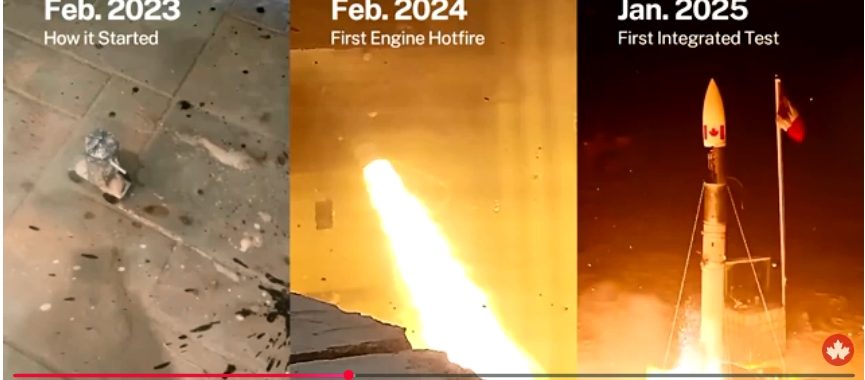
Um so it started on my porch basically in 2023. So it was me and our chief
propulsion uh engineer Luxman. Um we didn’t have really a facility uh exactly
then. Uh so we’re just blowing stuff up on my porch. I still have stains. I can’t get them out. Um, but you know,
less than a year later, we set up a facility. We hired a bunch of people on our team. We did our own in-house manufacturing, fired our first engine.
Um, less than a year later, we assembled our first vehicle, test fired that in a fully vert vertically integrated way
back in January. All went great. Uh, and then started building our second vehicle. April 2024, rewinding up, you
know, last year is when we identified our launch site for the ASX. um May 2025, so just a couple months ago, we
completed our month-long campaign uh with our new Dark Force engine test cell, the video that you saw um and
qualified our engine for flight. Um and uh you know, a bunch of other things
along the way. So, we have mostly our team uh we have half our team working on this flight that’s coming up and the
other half is working on things like space systems and orbital. So, we’ve been working on things like orbital tank manufacturing, uh turbo pumps, and
everything else. And I think one of the things I’m most excited about for this flight is being able to dedicate all the resources uh that we have right now on
this mission and move them over to orbital because we really need to get going on that um ASAP. So yeah, uh July,
you know, we had our vehicle ready uh launch rail and everything ready uh
launch rail and everything good to go. Just final final checks. Again, our team
hasn’t really slept in weeks. Uh just making sure that we get all of this going. uh they’re really like this
couldn’t happen without without our team and many of them are of course um were in your shoes just a couple years ago.
So uh it’s going to be pretty great. August like I said construction started um so so lots of big milestones uh we’ve
been crossing our first satellite’s going to be ready for inspiration by January. Uh and um yeah lots lots on the
horizon. So like I mentioned the reason we’ve been able to move pretty fast is private capital. Um and one of the
reasons of course is number one definitely is our team. Um but you know uh significant personal commitment but
also the commitment of everyone on our team as well. Just tremendous personal sacrifice. Uh but we’re able to really
make our own decisions and I think that’s what’s allowed us to move really fast. Um and given me confidence as an
investor in our own company that I can keep investing more. Um, and we’re really trying to do something hard here,
which is trying to have the lowest program cost and not dilute our cap table at all before we uh perform our
first orbital flight. Uh, we think that’s going to really um get our unit economics down so much to a point where
when we’re managing our own spaceport, managing our own bus, managing our own rocket, and managing our own cap table entirely, uh we can have a very
compelling uh rocket program here in Canada. Launch is within reach for Canada as well from like a finance
perspective. One of the other misconceptions when we talk to people, again, you you all know this, but
outside people who know launch, it’s like it’s going to cost Canada like billions of dollars to build a launch vehicle. It’s not. I mean, and there’s
no reason. I mean, you can spend billions of dollars and people have uh but also the most successful companies
haven’t. Uh SpaceX had Falcon won for about 80 million almost 20 years ago, Rocket Lab 95. And these are brilliant
companies. I mean, it’s it’s bold of us, even compare ourselves to companies like these, but I think we have the right
ethos and I think we have the benefit of modern technology and um and I think we can do that for for even cheaper. Um so
anyway, uh we’re working right now in our phase B through a lot of different means. Uh again, we’re really trying to
avoid private capital. Um but that’s going to get us to our first orbital flight and phase C will allow us to
fully scale this thing up. So we’re aiming to do this for about 100 million cash. Um, I wanted to like mention because I I
think it’s just the coolest thing ever. Uh, and that we have two rocket companies here in Canada. I think one of the cooler things also is that the
approaches are just so different. I think this is really important um, for Canadians uh, broadly who are not
necessarily building the rockets but to know that um, you know, one of these approaches has got to work. on one end
you have the you know us doing like end to end like you know doing all this other stuff to like really make sure
that we have the entire ecosystem around us to make launch successful and then you have reaction dynamics like brilliant engineers like Zach really
focused on making launch happen um and uh and and I think that’s just the the difference is really great completely
different propulsion uh methodologies and philosophies behind it as well and also we’re really trying to aim for the
larger payload class which is obviously comes with a lot of challenges um and uh
one of these has to work and uh so um you know for Canadians sake as long as
one of them works I think it’s great but it’s really awesome to have two uh two bets and it’s an honor to to be uh you
know in this healthy race uh with reaction amendments. So um what I’ve learned so far I think this is pretty
important. It’s kind of an opportunity for me to reflect as well a little bit. Um there’s certainly some some things
over the last year that I’ve completely changed direction on and I’ll tell you a little bit about those and some that
have been like really reinforced and hopefully some of these are interesting uh to you. Um and and this is really
from the lens of like a commercial company not as students. I think one of the biggest challenges for us, even for
me, was to unlearn the student mindset and move into a professional mindset
where it’s honestly business decisions that drive so much of what we do and not the engineering challenge of it. One of
the things I loved about being a student is we could just do things because they were hard. Um, that’s not a luxury we
necessarily have uh as a as a commercial company. tell you a little bit about that. But number one, and this hasn’t
changed for me, is time is everything. It, you know, I I have some benefit of
being an entrepreneur before this in another context as well. And uh and it’s just dawned on me so many times that um
when when somebody doesn’t appreciate just the value of time, it it becomes really hard, at least for me to
personally work with them. So, a lot of people ask like, “What do you look for when you’re hiring at Nordspace?” And I put this photo up. I’m guessing most of
you watch Interstellar. It’s one of my favorite scenes because if you listen to like a soundtrack, they have this like
metronome with the, you know, every tick, like every second. And for better or for worse, that’s like inside me
every second of my life. I can’t stop this thing. I have this like metronome going and it’s like it’s like setting the pace for my life. It’s usually like
a great thing. Sometimes it drives me bananas, but um that’s what I look for personally when I’m hiring uh among
other things. And what what I look for when we look at partners to work with us, whether they’re partners on the
ground or partners for uh people who are going to supply things for us on a rocket uh or launch with us, do they do
they have that same sense of urgency? Do they have the same appreciation for time? And uh if they don’t, we don’t
work with them. Like straight up, we don’t work with them. But if they do, or if they’re even close and we know we can sort of sync up with them, then then we
then we do. So time is everything for us. Um, and that that guides so many of our decisions. Um, and uh, you know, you
you’ll see some of that as I go on. The other thing I’ve really like cemented, I
kind of had this inkling last year, but I it became really apparent to me that building something small is just about
as as hard as building something big. So, go big every single time. It’s going to be a little painful in the beginning.
There’s like a bit of a mental barrier there. Um but at the end of the day especially with rockets things are so
complex um space in general that you know aim aim higher there’s no the
marginal difference uh is is actually very minimal at least so far in our experience and I’ve heard this advice
from many others as well. So that’s why we’re aiming for larger rockets and larger capabilities. That’s why we’re aiming for this endto-end capability. Um
and and it’s kind of really starting to settle in now. the the whole like shock shock factor around that like can we
actually do all this has has gone away and now it’s very very tactical very operational where we’re actually figure
out how to make all these pieces come together but it’s definitely scary to start but I if I if I can you know I I I
want to see the next I want to see Canada be the ones to even attempt like the first student orbital flight I think
we can do this um something I totally didn’t appreciate last year that I do
now is um being honest about mission objectives uh I kind of completely glossed over
mission objectives. I knew about requirements uh and really understood them. Um and you know I talk about like
deleting requirements constantly and making things as simple as possible. But I think mission objectives really become
your north star uh for everything that you do in a company like this one because this is where I think unlearning
the student mindset has been most uh apparent. Um cuz you know when you start
a when we started a rocket company we’re like we want to build our suborbital we we want to build a rocket that you know
um you know like for a really good example is actually our flight that’s coming up. We we had this decision to
make um do we want this to be like a space shot or do we want to just look what what what are we trying to achieve
with this rocket and what is the consequence for time. So one of the biggest things was how high do we think want this thing to go and what is the
marginal gain uh with doing that and it became apparent that it would take us an extra six months roughly u maybe a year
um to actually get to that point by adjusting a rocket to get there but the value was so minimal within the first
call it 10 to 30 seconds of flight we’re able to actually learn everything that we needed to that that that we wanted to
again there is marginal gain um so our mission objective was clear the launch rail let this thing burn for about 10
seconds or whatever we need to and move on to orbital. And that’s exactly what we’re doing because as an orbital launch
company, that’s our priority. But if we were, you know, uh, in the mindset where we just wanted to do really amazing
things because they’re challenging, um, we might not have made that decision. So, this doesn’t apply necessarily to
every company, but certainly goes for us. Um, this is something also that I’ve
been really reflecting over. I think it’s very important for a company, especially one like ours or launch
companies in general, to really understand their why, whether you like SpaceX or not, and my feelings about
SpaceX have changed a little bit over time. Um, I think they’ve been pretty consistent. You know, civilization on
Mars, all that stuff. Great. I think that’s cool. That sort of like drives you forward as a company. I don’t think
for a launch company, it’s enough to just be like, we want to build rockets because it’s like important. And you
know even like the sovereignty aspect is like it’s it’s pretty big but it’s still not enough. Um and currently for us you
know it’s about we have this vision that every country around the world friendly
country we want to make them a space fairing nation and we want to be able to develop the formula end to end here in
Canada by making Canada a true space fairing nation first and then copy and paste that capability all around the
world so that every nation on earth has the ability to reach space on their own and build their own space programs. So
that’s what we’re really focused on over the next decade and that’s what’s driving a lot of our why. But I think if
you’re going to start a rocket company, it’s really important to have a why beyond just we want to build rockets because they’re awesome. And they are.
Um little controversial, but I’ve always maintained that I think Canada has a serious innovation problem. We really overindex on innovation. I don’t want
this to sound like I’m discouraging innovation. I think actually the best place for innovation is where you guys are right now as students. The
consequence isn’t nearly as high. And why are you doing this? at least why I was doing it as students as a student
was to learn as much as I possibly can get as many hands-on skills as possible and I think the innovation should come
from universities should come from students but when it comes to building a capability which is what we need here in
Canada not a technology we need to depart a little bit from trying to find
innovative differentiators with every single thing we do and just build something that works we need to build
you know the the the Ford pickup truck that gets us to orbit and that values us the luxury to then start investing in
other innovative projects. So, let the business case guide you. I know that doesn’t sound cool. I know you want the
engineering side quest to be the be all and end all and that’s the fun stuff. We’re all engineers here, but at the end
of the day, if you’re building an honest business, you have to let the business case guide you and focus on first principles.
Um, the last couple of things, I really find that we’ve tended to overestimate what we can do in a day and really
underestimate what we can do in a month or a year. And this is something that we’re just constantly, especially me, trying to like calibrate and like force
myself out of. Um, and this is especially true, I think, for very complex projects. Um, so by constantly
like talking about this as a team, uh, and talking about it with your peers, it really helps you kind of reframe things
and make sure that you’re actually trying to be realistic about what you can do in a single day, but not unre not
not, uh, underestimating actually what you can do in the longer term.
So this is one thing again from the student side I had to unlearn and it was a pretty painful one. It actually cost
us probably a whole year on our program timeline. We could have been where we’re at now like last year. Um
so first it’s really expensive rocket hardware as you all know. And second it’s just like fun to like build stuff.
Uh, so you know, one of my earliest examples of this was trying to cut costs
and all of that, right? Like for a first engine test cell, we needed a DACK and we’re like, man, like we don’t want to drop 30 grand on like an NI system and
then, you know, another 30 on cards and all of that. We’re going to go with like labjack, which no offense, I’m sure many
many of you are using that. Oh, that was a really bad idea. Um, and that that you know, we we lost a lot of time. Uh, a
lot of time and time is time is money. So that was a major mistake and that really you know reprogrammed my mind.
It’s like look we’re serious about building a rocket company. There are certain things we have to invest in and we have to do it right and focus not on
kind of the enablement side. Let people who’ve already figured that out do that thing and we focus on the on the
engineering of the rockets and and do that. Another really good example is I this was a top down thing for me. I’m
like we have to build all our PCBs inhouse because that’s the way we vertically integrate everything and
that’s the way to do it. And we were building like PCBs to control like servos and stuff and it was just a total
nightmare because it adds months to your timeline. Um, and you don’t need to do it. You just like go online and you buy
this thing even from from like in some cases like from Amazon. These are like like acceptable devices. I’m not saying
that that’s where we get our all our like high performance gear from. But a
lot of stuff is out there. Why why build stuff when you can buy it? But again on the student side, I think it makes total
sense. Seeing custom PCBs, seeing you guys make, you know, a lot from a little. I think that’s what the student
experience is all about. But we really had to unlearn that. I had to unlearn that um over the last year, especially
uh after some very very painful and very expensive and costly mistakes on that front. Oh yeah. Um valves, they really
suck. Um so, you know, if I if there’s one reason to build solids, it’s like
less valves for sure. Um, and it’s kind of comes down to the same thing, like hacking away with like uh like Toys R Us
valves versus like calling it new space versus like just just getting the the good quality stuff or at least like
medium quality stuff. Like it makes a big difference. So, um yeah, but uh this
is not the end of our our terrible experience with valves. Uh we’re proud to be sponsoring a bunch of teams here
today. We also sponsor rocket uh robotics, satellites, and all kinds of other things as well. I is really in our
DNA. I wish more of our team could be here today, but they’re just so busy. Uh but we’re trying to do more things um
including create other competitive environments uh for students.
The last thing, you know, um Apollo the average age to get people to the moon like I mean if they could do this like
what I don’t know like well over 60 years ago I I guess now like come on we
can do this. uh 28 years. I think like I said, students are going to pave the way for Canadian space flight for opening
everything space. You heard Zach said it as well. How many of their team members at at Reaction Dynamics are from our
students uh from Launch Canada and Rocket Teams, same deal in our case, we can’t do what we do without Launch
Canada and without you all. Um and I think one of the coolest things is that they come in to a company like ours and
they still believe the impossible is possible. And um we try to maintain that. I try to maintain that personally
as long as it possibly can and there are some realities of working you know in in in in the professional world but um the
impossible can be made possible and and and believe this I ask this every single time as my last slide do we choose this
is a choice I think we consciously can make as Canadians are we going to be leaders are we going to be participants I’m tired of being participants I think
we can lead I know we can lead a huge economy we have amazing talent you all
go everywhere else and build other people space programs. We can do that here. So, let’s lead, guys. Thank you
for your time today. Um, and and congratulations and good luck with your launches.
[Applause]
Beautiful presentation really. Um, and you know, I’ve had a chance to see Rahul speak a few times by now and assist them
and every time I end up being more excited than the previous one. I got to say congratulations and thank you. Do we
have any questions from the audience? I do one have one to start the ball if
that’s okay. Okay. I do have one to start if that’s okay. Um like I said, every time you speak I’m
flabbergasted at your speed and how you achieve things in so efficient little
time and big milestones. any recommendations to entrepreneurs out there, students that want to start
engineering in a hard projects in Canada on how they can achieve hard technical milestones in so short amount of time in
the regulatory environment that we have in aerospace. Yeah, I mean it’s it’s a it’s really
mostly a cultural thing. I mean you need somebody on the team who has that like metronome that drum beat I was talking
about. That was that’s why my first lesson learned about just the importance of time. Um, and often it comes down to
like the the first person on that team and they set the pace. And I, you know, you see that in sports, you see that
everywhere, you have, you have people that set the pace. And I think it’s really important to recruit leaders as
well on your team. I one of the things that’s often done in companies um is uh
you hire CEOs, right? And and and not every founder is necessarily ideal to be
a CEO. I don’t know if I am, but I’m in this role right now. So um but one of
the qualities I would look for if I was in in a student team is maybe you find somebody that’s not necessarily an
engineer but has great management style and they are able to set that pace for you and help you with project
management. Um, one of the things that helped us tremendously was uh, a year ago we had uh, Derek uh, join us on the
operations side and um, you know, he’s also an aerospace engineer but doesn’t do any technical work but without his
input on project management and like actually taking the sheer chaos that I’m constantly funneling towards him and
like distilling that down into project management plans, speaking about it in a calm way um, and like uh, that that just
makes a world of a difference. So, it’s not enough to just be able to like talk about doing things fast like, you know,
like cracking a whip or something. You really need to have a plan around that. We’re still learning how to do that effectively. I think we can move 10
times faster. Um, it’s just trying to avoid the mistakes, some of the ones I’ve talked about as well.
So, find the right people. Thank you. People are everything. Yeah, for sure.
Hey Julia.
Uh hello. Thank you. Um I just have a few questions about your uh printed engine. Um in particular, what kind of
heat treatment process do you guys do on your engine? Um and I also wanted to ask about the envelope of the of the size
prints that you guys have. Uh you talk about heat treatment. Yes. Okay. Um, I can’t tell you the
exact profile, but you know, we have a furnace uh in our facility. We run it for about 36 hours. Um, so that thing
comes out looking pretty uh not pretty. Um, you know, uh, but um, uh, I can
maybe tell you a little bit more about that offline, but we’ve done a bunch of structural tests. Um, you know, we
started with like 3D printing and then ran coupons inside there, done pencil tests and all kinds of other tests. Figured out what the ideal situation
was. Um, so yeah, we bake the thing and um, for the printer, so right now we
have our our first printer in our currently our only printer. Uh, it’s roughly about like 50 centimeters by 50
by 50. Um, a little bit just a little bit smaller than that. Uh, but we’re looking now to get two new capabilities.
One on a laser DED um, side and another which might be at the meter scale for
powder bed fusion. So um yeah um we haven’t announced it yet but we have
we’re we’re we have something big coming on on the on the additive manufacturing side. Wow. Thank you very much.
Yeah.
Hey Rahul. Uh I just wanted to ask what your plans are for scaling up manufacturing capabilities uh so you can
have that high launch cadence. Scaling launch capabilities. Is that what you have? Scaling manufacturing.
Um yeah, I mean we try to use other than 3D printing which arguably can be called
conventional to in some circles now. Um we really try to like stick to conventional everything. So that’s why
like conventional propellants, conventional manufacturing processes as as best we can. Um so that just lends
itself to us being able to use almost any machine shop um and and produce what
we need in high quantities. Our goal is definitely to do that in-house as much as we can. But if we’re not using highly
specialized equipment, then that means that we can leverage third parties, you know, if we get a if we get demand for
like somebody needs 100 launch vehicles uh like tomorrow, um we can find a path
to make that happen uh because we’re not necessarily like creating our own machines and creating our own processes
around that. But I think as much as we think about scaled manufacturing, it’s not something that necessarily keeps us
up at night. Um uh right now we call what we have like kind of a manufacturing lab. Um we’re looking in
the next year to quadruple the size of our facility and that’s going to be where we’re actually going to be doing
some more production scale. Awesome. Thanks. Sure.
Hi R. Just real checking in. You left off at valves suck and that’s so very
true. In your experience, can you uh share with us valves that you’d say
don’t touch, don’t even bother. You’re wasting your time. We’ve learned the hard way.
Tell you about valves that don’t suck. No, the valves that made you really say
valves suck. The ones that you’re saying don’t waste your time on. Yeah. Yeah. Yeah.
Um, I mean, honestly, it’s just it’s us using valves. So, there’s certain places
in our in our fluid control systems where we actually can use valves that aren’t like purpose-built for like
rockets or very advanced aerospace and we get away with them. I think really it’s a lot of the cryo valves that give
us some of the challenges and it’s it’s um it’s us trying to cut corners like
you know a year ago, year and a half ago, not even cut corners like cut expense. I mean, a single high quality valve can cost over $10,000 easily, like
a single valve. So, you know, if we can get one that’s 500 or a thousand and like retrofit it for our systems. So, I
don’t want to like necessarily dunk on valves that we use because we’re kind of using them in a way that they weren’t
necessarily meant for. And they actually do work. Like, I mean, uh, we we can make them work. There’s certain areas
where we’re now like we’ve invested in higher quality valves and regulator.
It’s mostly our fault, I would say. so far that we’ve uh mostly my fault I would say for for why we I have that
impression.
Hi Rul. So you had a pretty good part on uh making a business case for aerospace
company like this and I kind of had two questions about that. So what do you think is going to give you a competitive edge over like these small budget rocket
companies like Rocket Labs in the states and what challenges do you see yourself overcoming towards a road of profit
profitability? Couldn’t exactly hear that question. I think business case and rocket lab.
Yeah. So what do you think is going to give yourself a competitive edge over uh budget air like budget aerospace
companies like Rocket Labs? And then what challenges do you see yourself overcoming towards a road to profitability?
Um I I mean I honestly I think it’s going to be really hard to compete against a company like Rocket Lab, especially out of the gate. Like they’re
a fantastic company. A lot of what we do is model after them. Um our market research uh indicates that
there’s going to be quite a lot of demand for access to space for getting assets to space. Uh it’s only
increasing. So our initial target market would be serving Canadian needs. We
think we could probably do um you know anywhere from like five to 10 dedicated launches just to serve the Canadian
market first and then scale that up depending on which direction we need to head to whether it’s building launch
capabilities like I you know aspired to in my presentation for other countries or just offering another solution. I
mean other than SpaceX and rocket lab there really aren’t that many I guess friendly nations that are regularly
launching right now. Um, so whether it’s on the, you know, spaceport side, launch vehicle side, or anything else there,
it’s a bottleneck. I think there’s a couple of really good companies that are up and coming way further ahead than us.
Um, the last couple years have, you know, kind of filtered through some of the other companies that weren’t going to make it, which I think is it’s nice.
It’s left like kind of a new field for us to operate in, but it’s going to be tough. Like I don’t think we’re ever going to plan to go head-to-head with
Rocket Lab and that be our business case right out of the gate. Um, they’re a fantastic company.
Thank you, Raul. Um, as the original investor in your company that you put your own money into,
what discipline, if there’s one, would you say that when you wake up every day about putting your own money, your
family on the line to do this, what’s one discipline that you could share with the audience when it comes to uh an
entrepreneurial mindset? Like what’s that one discipline that that’s a guiding principle for you that lets you
be the leader that stands up here and say we can do it. Have a can do attitude. So the question is what’s
what’s your most important principle as an entrepreneur when you put your own capital in?
Um well I mean in my case I it’s something I sort of committed myself to so long ago. Uh and
you know I’m the kind of guy like when I make a promise I do everything I
possibly can to keep it. Uh especially if I make a promise to myself. So I I you know I think that fundamentally is
really important. Um initially it was you know I talked about finding your why
like for most of my life it’s like I wanted to build a space company because it’s just so cool and then it became apparent to me you know after undergrad
and after building another company and becoming a taxpayer and all this that like this is really more a there’s so
much more to it. National security is definitely one thing that’s topical today. But I hate seeing our jobs like
disappear. I hate seeing our tax dollars disappear. I hate seeing our IP disappear and um and I want to raise the
standard even for aerospace engineers in Canada in terms of their compensation, in terms of everything else. Uh so that
drives me a lot these days. Space is like maybe 25% of it and that’s a really critical part of it. But I just I’m so
committed to to seeing Canada industrialize. Uh and I think we have this unique positioning in the space
side that we can focus on and make make happen. But hey, it’s a it’s definitely a a pretty scary uh situation. But, you
know, I I didn’t I I came from nothing. So, um you know, I almost feel like I
don’t have anything to lose. I I have a house and I have a car that I’m not going to put those on the line. Um but everything else I’m ready to dedicate to
Canada. What a great way to finish this question
period. Uh talking about Can you hear me? Well, yes. So one thing personally
that affects me is seeing some of my smartest colleagues finished their degree. They were raised in Canada. They
got educated in Canada. Then they go to the US to work. And everybody have makes their choices. But thank you for
providing the opportunity to keep our students here. So everybody one more round of applause for Nordspace and
Rahul Goel.