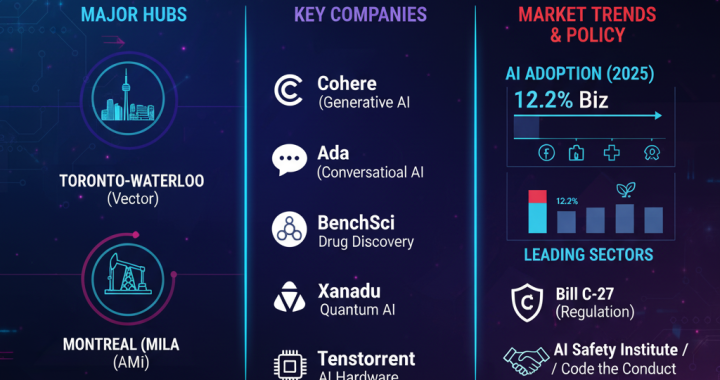
Overview and Ecosystem Strength
Canada is one of the world’s top-ranked nations for AI research, talent, and commercialization, largely due to a deliberate national strategy and foundational research breakthroughs in deep learning.
- Pan-Canadian AI Strategy (2017): The world’s first national AI strategy provided significant government funding for research and talent retention, centered around three national institutes.
- Talent Concentration: Canada, and especially its major tech hubs, has one of the highest concentrations of AI talent globally.
- Government Commitment: The Canadian government continues to support the sector with multi-billion dollar investments, including a focus on building domestic AI compute capacity.
Major AI Hubs (The “AI Triangle”)
The Canadian AI landscape is heavily concentrated in three major research and business hubs, each anchored by a national AI institute.
Key Canadian AI Companies and Startups
While many large global tech companies have labs in Canada, the homegrown startup scene is highly dynamic.
Market Trends and Adoption
The Canadian AI market shows a strong trajectory, with certain sectors leading the way in adoption.
Government Initiatives and Regulation
The Canadian government is actively shaping the AI environment through policy:
- Bill C-27 (Artificial Intelligence and Data Act): This proposed legislation aims to establish one of the world’s first national regulatory frameworks for AI, focusing on mitigating risks and ensuring responsible use.
- Canadian AI Safety Institute (CAISI): Established to focus on the research and mitigation of risks associated with advanced AI systems.
- Voluntary Code of Conduct: Encourages companies developing and managing advanced generative AI systems to adopt principles of responsible innovation.
In summary, the Canadian AI sector is characterized by a mature research base, thriving regional hubs, and a growing ecosystem of commercial startups, all supported by significant government commitment to both innovation and responsible development.
Sources
- Canadian Sovereign AI Compute Strategy,
https://ised-isde.canada.ca/site/ised/en/canadian-sovereign-ai-compute-strategy - One of the world’s biggest AI companies wants a deal with Canada. Is sovereignty the trade-off? | CBC News,
https://www.cbc.ca/news/business/open-ai-canada-data-centres-digital-sovereignty-9.6935195 - Artificial intelligence (AI) | OSC – Ontario Securities Commission,
https://www.osc.ca/en/industry/artificial-intelligence - From Potential to Performance: Roundtable Report on Canada’s Investment in AI Compute Infrastructure – The Dais,
https://dais.ca/reports/from-potential-to-performance-roundtable-report/ - Analysis on artificial intelligence use by businesses in Canada, second quarter of 2025,
https://www150.statcan.gc.ca/n1/pub/11-621-m/11-621-m2025008-eng.htm - Consultations on Artificial Intelligence (AI) Compute,
https://ised-isde.canada.ca/site/ised/en/public-consultations/consultations-artificial-intelligence-ai-compute - Analysis on artificial intelligence use by businesses in Canada, second quarter of 2024,
https://www150.statcan.gc.ca/n1/pub/11-621-m/11-621-m2024008-eng.htm - canada’s ai ecosystem – government investment propels private sector growth – University of Toronto Government Relations Office,
https://gro.utoronto.ca/wp-content/uploads/2022/04/Canadas_AI_Ecosystem-_Government_Investment_Propels_Private_Sector_Growth.pdf - Mapping the Growth of AI in Canada Through Investment | CVCA Central,
https://central.cvca.ca/data-analysis/mapping-the-growth-of-ai-in-canada-through-investment/ - Canada leads the world in AI talent concentration – Deloitte,
https://www.deloitte.com/ca/en/about/press-room/impact-and-opportunities.html - Pan-Canadian Artificial Intelligence Strategy,
https://ised-isde.canada.ca/site/ai-strategy/en - Responsible use of artificial intelligence in government – Canada.ca,
https://www.canada.ca/en/government/system/digital-government/digital-government-innovations/responsible-use-ai.html - 4 GOVERNMENT RESPONSE TO THE STANDING COMMITTEE ON HUMAN RESOURCES, SKILLS AND SOCIAL DEVELOPMENT, AND THE STATUS O – House of Commons,
https://www.ourcommons.ca/content/Committee/441/HUMA/GovResponse/RP13242181/441_HUMA_Rpt19_GR_PDF/441_HUMA_Rpt19_GR-e.pdf - Mapping Artificial Intelligence Use in the Government of Canada – Érudit,
https://www.erudit.org/en/journals/gouvernance/2023-v20-n1-gouvernance08729/1106045ar/ - Towards a Better Public Sector AI Strategy,
https://cappa.ca/wp-content/uploads/2023/06/Will-Alexander-Original-paper-EN.pdf - Artificial Intelligence and Canadian Government Science: A Discussion Paper,
https://iog.ca/wp-content/uploads/2025/01/2023-09_IOG_AI-in-government-science_Final_EN.pdf - Securing Canada’s AI advantage | Prime Minister of Canada,
https://www.pm.gc.ca/en/news/news-releases/2024/04/07/securing-canadas-ai - Government Of Canada Launches Inaugural Artificial Intelligence (AI) Strategy For The Federal Public Service – Capital Hill Group,
https://capitalhillgroup.ca/government-of-canada-launches-inaugural-artificial-intelligence-ai-strategy-for-the-federal-public-service/ - (PDF) Artificial Intelligence Policy and Funding in Canada: Public Investments, Private Interests – ResearchGate,
https://www.researchgate.net/publication/360275505_Artificial_Intelligence_Policy_and_Funding_in_Canada_Public_Investments_Private_Interests - ARTIFICIAL INTELLIGENCE STRATEGY – à www.publications.gc.ca,
https://publications.gc.ca/collections/collection_2024/mdn-dnd/D2-633-2024-eng.pdf