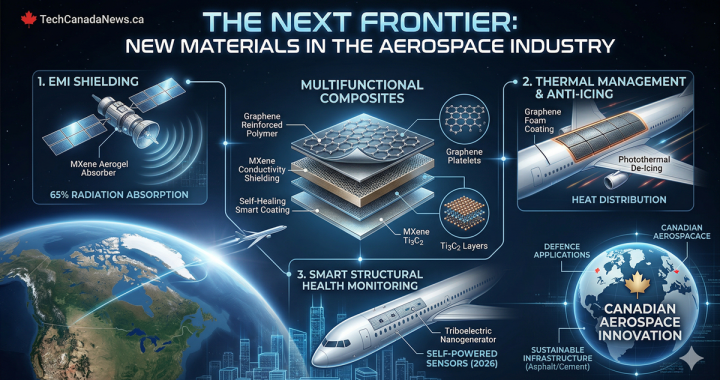
As Canada’s aerospace and defense sectors move toward more sustainable and autonomous operations, a material revolution is quietly taking place. No longer content with materials that simply offer strength, the industry is pivoting toward “multifunctional” systems. From graphene-integrated composites to the rise of MXenes, the latest research is turning the very skin of an aircraft into a protective, self-sensing organism.
1. Beyond Graphene: The Rise of MXenes and Borophene
While graphene remains the “wonder material” of choice for structural reinforcement, 2D transition metal carbides, known as MXenes, are stealing the spotlight in 2026. Unlike graphene, MXenes are highly hydrophilic and offer metallic-like conductivity.
Current research is leveraging these properties for Electromagnetic Interference (EMI) shielding. Traditional shielding requires heavy metal foils; however, a new MXene/graphene hybrid aerogel can absorb up to 65% of incident radiation with minimal thickness. This is a game-changer for the proliferation of satellite-embedded electronics and the growing drone market in Canada.
2. Smart Skins and Self-Heating Wings
One of the most immediate implementations is in thermal management. The European Space Agency (ESA) and various North American partners are now piloting “smart textiles” and coatings that do more than just insulate.
-
Anti-Icing: New graphene foam coatings provide a continuous conductive network that allows for photothermal de-icing. By absorbing solar energy and converting it to heat with near 100% efficiency, these materials reduce the need for energy-intensive chemical or mechanical de-icing systems.
-
Self-Powered Sensors: Projects like the 2026 GRAPHERGIA initiative are successfully embedding miniaturized sensors directly into composite wings. These sensors are powered by triboelectric nanogenerators—meaning they harvest energy from the vibration of the aircraft itself to monitor structural health in real-time.
3. Sustainable Infrastructure and Defense
Translational science centers, such as the Center for Graphene Research and Innovation (CGRI), are bridging the gap between the lab and the runway. Their 2026 focus has expanded into “force protection” and sustainable infrastructure. By adding graphene to cement and asphalt, researchers are creating resilient runways and hangars that can better withstand the extreme temperature fluctuations of the Canadian climate, while simultaneously developing graphene-enabled body armor for defense personnel.
4. The Canadian Context
With the recent launch of Canada’s first Defence Industrial Strategy in February 2026, there is a push to scale up domestic operations. Companies like Magellan Aerospace are increasingly looking at these low-dimensional materials to maintain a competitive edge in global supply chains, particularly for the next generation of patrol aircraft and unmanned aerial vehicles (UAVs).
Reference Links & Further Reading
-
Graphene Energy Solutions: GRAPHERGIA: Three Demonstrators Enter Piloting Phase (April 2026)
-
University Research: The Center for Graphene Research and Innovation (CGRI) – University of Mississippi
-
Multifunctional Composites: Development of Graphene-Rare Earth-Based Composites for EMI Shielding (ACS Omega, 2026)
-
Aerospace Coatings: Coatings 2026: Safe and Sustainable by Design Surface Treatment (MDPI)
-
Canadian Industry: Magellan Aerospace Agreements & Industry Updates