Launch the North: Accelerating Canada’s sovereign access to space

Launch the North is a Canadian government initiative designed to accelerate Canada’s sovereign access to space. The official website is here, and here’s an article on SpaceQ that provides an overview.

I wanted to know who the front runners are on getting the grants, the application document states, “Up to 3 winners will be selected, with the total prize pool of $25 million divided equally among them.”

Continue reading

Report on the Canadian Artificial Intelligence (AI) Sector

Overview and Ecosystem Strength

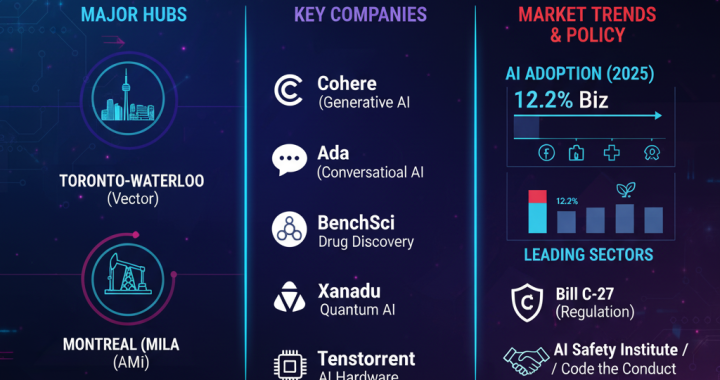
Canada is one of the world’s top-ranked nations for AI research, talent, and commercialization, largely due to a deliberate national strategy and foundational research breakthroughs in deep learning.

  • Pan-Canadian AI Strategy (2017): The world’s first national AI strategy provided significant government funding for research and talent retention, centered around three national institutes.
  • Talent Concentration: Canada, and especially its major tech hubs, has one of the highest concentrations of AI talent globally.
  • Government Commitment: The Canadian government continues to support the sector with multi-billion dollar investments, including a focus on building domestic AI compute capacity.

Continue reading

Interviews with Nordspace Engineers

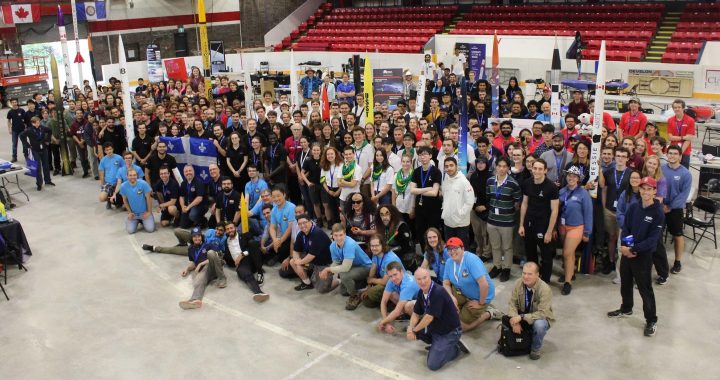
The following summaries and transcripts were created with NotebookLM from the following video which was streamed live on September 23rd during the Nordspace launch attempt. The launch didn’t proceed due to “A pad anomaly has caused residual vaporized fuel to cause a minor pad fire.” This was later qualified, “the root cause has been discovered to be related to our propellant quality slightly differing between vehicle tests at our test facility in Ontario, compared to our first launch test in Newfoundland and Labrador at our spaceport.”

We produced three summaries from the interviews with Hubert Fortier, David Diaz and Lakshmanan Velappan. We also appended below the raw transcripts created by Ai which may contain some spelling errors. If there are factual errors in the summaries, contact me at editor@nanographene.org

Continue reading

NordSpace Launch License Process

I thought it would be interesting to query Ai on the process that NordSpace would have to follow in Canada to get a launch license. This is the information it returned, if I get further updates and corrections I’ll note them here.

[update on X from Rahul Goel, CEO of Nordspace: Mostly right. Reality is far more challenging. E.g. the regulations set a hard limit on wind speeds not exceeding 30 km/h. Makes senses for small rockets or solid motors, but our vehicles can handle far greater speeds and trickier scenarios. Forces us to keep scrubbing launches.]

What process does NordSpace have to follow to get a launch license?

Continue reading

Executive Summary: Graphene’s Commercial Tipping Point

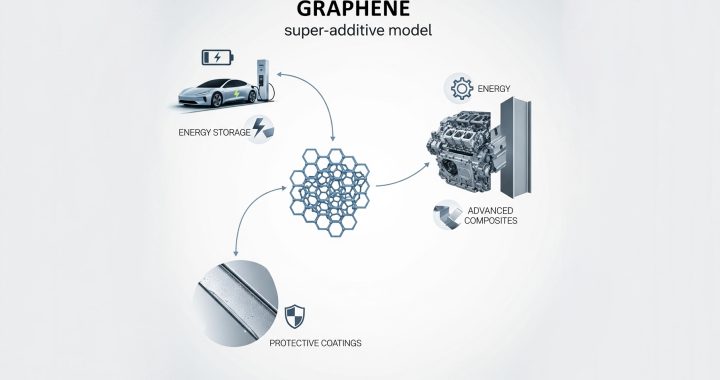
Graphene is at a critical inflection point, moving from a material of immense scientific promise to a viable commercial reality. The market is demonstrating a rapid growth trajectory, driven not by a single “killer application” but by graphene’s versatility as a performance-enhancing “super-additive.” This transition is being enabled by a recent wave of innovative, cost-effective, and scalable manufacturing methods that directly address the historical barriers of high cost and limited production volume. While a lack of standardized market definitions leads to significant data variability, all forecasts consistently point to robust, double-digit growth.
Continue reading

SpaceX Starship Program Overview

The Starship program, developed by SpaceX, is a fully reusable, super heavy-lift launch vehicle designed for crew and cargo missions to Earth orbit, the Moon, Mars, and beyond. Here’s a concise overview:

Overview

  • Components: Starship comprises the Super Heavy booster and Starship spacecraft (Ship), powered by Raptor engines (33 on Super Heavy, 6 on Starship). It stands ~121 meters (398 feet) tall for Version 2, with larger versions planned. https://www.spacex.com/vehicles/starship/
  • Purpose: As the world’s most powerful launch vehicle, Starship aims to enable affordable space travel, lunar missions, Mars colonization, and deep-space exploration, with a payload capacity of up to 150 metric tons to low Earth orbit (LEO) reusable or 250 tons expendable. https://www.spacex.com/vehicles/starship/

Continue reading

NordSpace Rahul Goel Presentation at Launch Canada 2025

The following information is presented below, a briefing document generated by NotebookLM (with some manual edits), the original YouTube video, and the transcript generated by YouTube. The purpose is to have a more permanent record of the presentation that is search engine discoverable for future reference and ease of access. Since Ai does not phonetically interpret everything 100% correctly, view the video if in doubt about the veracity of a statement.

Continue reading

HydroGraph Graphene the Foundation of New Biosensor for Lung Cancer Test

HydroGraph a leading producer of ultra-pure graphene, today announced its role in a new lung cancer screening product underpinning a collaboration between Hawkeye Bio (Torrance, California) and Ease Healthcare (Pasadena, California). Under a new commercialization agreement, Ease Healthcare will market the LEAP (Lung Enzyme Activity Profile) early detection test that incorporates HydroGraph’s patented fractal graphene.

Continue reading